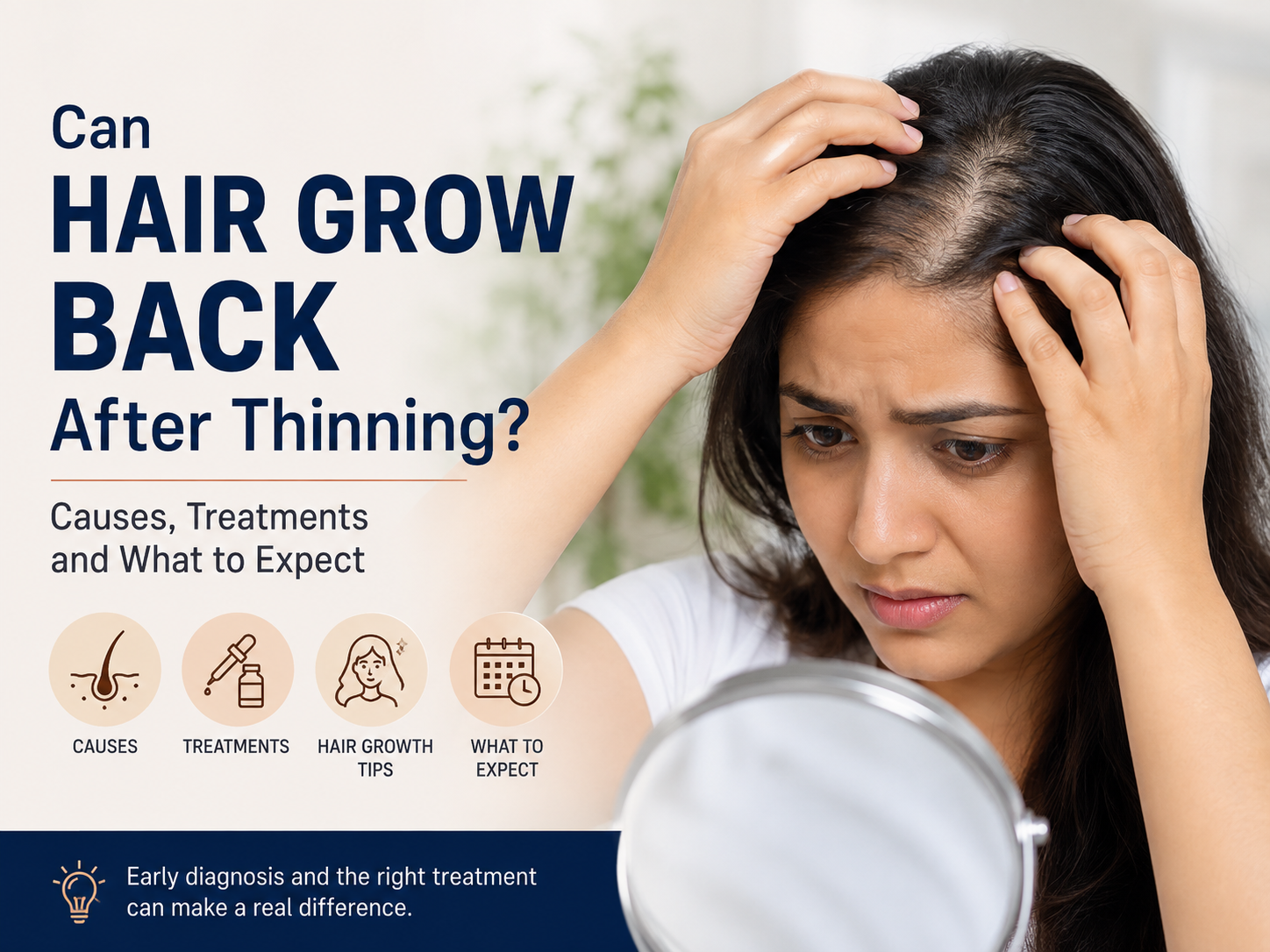

Noticing that your hair looks thinner than it used to can be worrying. You may see more of your scalp when looking in the mirror, notice that your hairline has changed, or find that your ponytail feels less full. One of the first questions that naturally comes to mind is: Can thinning hair grow back?
The answer is yes, in many cases hair can grow back after thinning — but it depends on why the thinning is happening and whether the hair follicles are still capable of producing hair.
Some types of hair thinning are temporary and may improve once the underlying cause is corrected. Other types, including hereditary hair loss, tend to progress over time but may respond to treatment, particularly when addressed early.
Understanding the cause is therefore much more important than simply trying different hair oils, shampoos or supplements.
Can Thinning Hair Really Grow Back?
Hair can grow back when the follicles responsible for producing hair are still healthy or have not been permanently damaged.
For example, temporary hair shedding after an illness, major stress, childbirth or nutritional deficiency may improve after the trigger has resolved. In hereditary hair loss, the follicles gradually become smaller, producing finer and shorter hairs. Treatment may slow this process and, in some people, improve hair growth.
However, if follicles have been permanently destroyed — as can occur with certain forms of scarring alopecia — hair generally cannot grow again from those follicles.
This is why early evaluation matters.
If you have noticed a significant change in your hair density, consider consulting a dermatologist rather than waiting until the thinning becomes severe.
Why Does Hair Become Thin?
Hair thinning is not a single condition. It is a symptom that can have many possible causes.
Finding the underlying reason is one of the most important steps toward determining whether your hair can grow back.
1. Genetic or Pattern Hair Loss
Hereditary hair loss, medically known as androgenetic alopecia, is one of the most common causes of gradual thinning.
In men, it commonly appears as:
-
A receding hairline
-
Thinning around the temples
-
Hair loss at the crown
-
Gradual development of bald areas
In women, it may appear differently, often as:
-
A widening hair part
-
Reduced density over the top of the scalp
-
Increasing scalp visibility
-
Overall thinning without complete baldness
Genetic hair loss causes susceptible follicles to gradually shrink. As the follicle becomes smaller, the hair it produces becomes thinner and shorter.
Treatment started during the earlier stages generally has a better chance of preserving existing hair.
2. Stress and Temporary Hair Shedding
Sometimes people experience noticeable hair shedding a few months after a stressful event.
This may occur following:
-
Major illness
-
High fever
-
Surgery
-
Significant emotional stress
-
Rapid weight loss
-
Childbirth
-
Major changes in diet
This type of shedding is often called telogen effluvium.
The encouraging part is that it is frequently temporary. Once the triggering factor has passed and the normal hair-growth cycle resumes, hair density may gradually improve.
However, recovery is not immediate. Hair grows slowly, so visible improvement can take several months.
3. Nutritional Deficiencies
Your hair follicles require nutrients to function normally.
Deficiencies involving nutrients such as iron, protein or zinc may contribute to hair loss in some people.
This doesn't mean everyone experiencing hair thinning should immediately start taking supplements.
Taking unnecessary supplements is not always beneficial, and excessive amounts of certain nutrients may actually cause problems.
Instead, persistent or unexplained thinning should be medically evaluated. Depending on your symptoms, medical history and diet, a doctor may recommend appropriate tests.
4. Hormonal Changes
Hormonal changes can also affect the hair-growth cycle.
For example, some women experience changes in hair density associated with pregnancy, childbirth, menopause or conditions such as polycystic ovary syndrome (PCOS).
Thyroid disorders may also contribute to thinning hair.
If hair loss occurs together with symptoms such as irregular periods, unexplained weight changes, persistent fatigue or other hormonal symptoms, medical evaluation may be particularly important.
Depending on the symptoms, a doctor may recommend evaluation by a dermatologist, gynecologist or endocrinologist.
5. Alopecia Areata
Alopecia areata is an autoimmune condition in which the immune system attacks hair follicles.
It often causes clearly defined patches of hair loss, although the pattern can vary.
Hair can sometimes grow back spontaneously. In other cases, treatment may be required to encourage regrowth or manage the condition.
If you suddenly notice smooth, round bald patches, don't assume that the problem is ordinary hair thinning. A dermatologist can examine the scalp and help determine the cause.
6. Hair Styling and Hair Damage
Not every case of thinning starts inside the body.
Your hair-care routine can also contribute.
Repeated use of hairstyles that tightly pull the hair can put stress on follicles. Over time, this can cause a condition called traction alopecia.
Frequent chemical treatments, excessive heat and harsh handling can also damage hair and increase breakage.
If the problem is identified early and the damaging practice is stopped, further hair loss may sometimes be prevented. Long-standing follicular damage, however, may become permanent.
How Do You Know Whether Your Hair Follicles Are Still Active?
You cannot always determine this simply by looking in the mirror.
A dermatologist may examine your scalp, evaluate the pattern of hair loss and check the health of your hair. Depending on the suspected cause, additional investigations such as blood tests or, in selected cases, a scalp biopsy may be recommended.
Doctors may look for clues including:
-
The location and pattern of thinning
-
Signs of inflammation
-
Scaling or redness
-
Hair breakage
-
Miniaturised hairs
-
Smooth bald patches
-
Scarring
-
Your medical and family history
This is another reason why getting the correct diagnosis matters.
Can Minoxidil Help Thinning Hair Grow Back?
Minoxidil is one of the commonly used treatments for certain forms of hair loss.
It can help stimulate hair growth and may help reduce further hair loss in appropriate patients. However, results vary from person to person, and it does not restore every type of hair loss.
It also requires patience.
Hair grows slowly, and treatment results generally need to be assessed over months rather than days or weeks. Continued treatment may also be necessary to maintain benefits in conditions such as hereditary hair loss.
Because different concentrations and treatment approaches may be appropriate for different patients, it is better to discuss treatment with a doctor instead of beginning medication simply because someone recommended it online.
What About Finasteride?
Finasteride is another medicine used for certain types of pattern hair loss, particularly male pattern baldness.
It works differently from minoxidil and is not appropriate for everyone.
Because finasteride can have side effects and specific precautions apply, it should be discussed with a qualified doctor before use.
Women should not start finasteride for hair loss without specialist medical advice.
The important point is that hair-loss treatment should match the cause, rather than choosing medication based solely on advertisements or recommendations from friends.
Can Diet Help Hair Grow Back?
A balanced diet supports normal hair growth, particularly when nutritional deficiency is contributing to the problem.
Hair itself is largely composed of keratin, a protein, so adequate dietary protein is important for normal hair production.
Useful dietary sources may include:
-
Eggs
-
Fish
-
Milk and dairy products
-
Lentils and pulses
-
Soy products
-
Nuts and seeds
-
Meat and poultry
-
Green leafy vegetables
Iron, zinc and several vitamins also contribute to normal body functions associated with healthy hair.
However, eating more of a particular food will not reverse every form of hair loss. If the cause is genetic, autoimmune, hormonal or related to follicular scarring, diet alone is unlikely to solve the underlying problem.
How Long Does It Take for Thinning Hair to Grow Back?
Hair regrowth takes time.
Even after the underlying cause has been corrected, you should not expect your hair to become noticeably thicker within a few weeks.
For some temporary forms of shedding, normal fullness may gradually return over several months.
The timeline varies considerably depending on the cause, severity of the hair loss, age, overall health and whether treatment is required.
When medical treatment is appropriate, visible results may also take several months.
Consistency and realistic expectations are important.
When Is Hair Thinning Less Likely to Be Reversible?
Regrowth becomes more difficult when hair follicles have been permanently damaged or destroyed.
This may occur with certain forms of scarring alopecia.
Long-standing traction alopecia may also permanently damage follicles.
With hereditary pattern hair loss, follicles can gradually become increasingly miniaturised. This is why seeking medical advice early can be valuable rather than waiting for a large bald area to develop.
Early treatment cannot guarantee complete regrowth, but it may provide a better opportunity to preserve existing hair.
When Should You See a Doctor About Hair Thinning?
Consider speaking with a doctor or dermatologist if you notice:
-
Sudden or excessive hair loss
-
Rapidly increasing thinning
-
Bald patches
-
A noticeably widening hair part
-
A rapidly receding hairline
-
Scalp itching, redness, pain or scaling
-
Hair loss following a new medication
-
Hair loss with fatigue or unexplained weight changes
-
Hair loss with menstrual or hormonal changes
-
Thinning that continues for several months
You should also seek advice if your hair loss is affecting your confidence or wellbeing.
A dermatologist can help determine whether your hair loss is temporary, hereditary, inflammatory, nutritional, hormonal or related to another condition.
Can Hair Grow Back Naturally Without Treatment?
Sometimes, yes.
Hair may recover naturally when thinning is caused by a temporary event and the trigger resolves.
For example, hair shedding following illness, surgery or a major stressful event may gradually improve without specific hair-growth medication.
But assuming that every case will resolve naturally can delay diagnosis of progressive conditions.
If thinning continues, worsens or creates visible areas of scalp, it is sensible to investigate the cause.
What Should You Avoid When Your Hair Is Thinning?
When people first notice hair loss, it is easy to start trying multiple products at once.
Instead, avoid:
-
Taking unnecessary supplements without knowing whether you are deficient
-
Frequently changing treatments before they have time to work
-
Wearing extremely tight hairstyles
-
Excessive heat or chemical processing
-
Aggressively brushing or pulling wet hair
-
Depending entirely on oils or shampoos for progressive hair loss
-
Starting prescription medicines without medical guidance
Hair oils and shampoos may help with scalp or hair care, but they cannot restore follicles that have been permanently destroyed.
Frequently Asked Questions
Can thin hair become thick again?
Sometimes. If thinning is caused by temporary shedding, nutritional deficiency or another treatable condition, hair density may improve once the cause is addressed. Hereditary thinning may also respond to treatment, particularly when identified early.
Can hair grow back after years of thinning?
It depends on the condition of the follicles. If follicles remain capable of producing hair, treatment may provide improvement. If they have been permanently destroyed, natural regrowth from those follicles is unlikely.
Does shaving your head make hair grow back thicker?
No. Shaving cuts the hair above the skin. It does not increase the number of hair follicles or change how much hair those follicles can produce.
Can stress cause hair thinning?
Yes. Significant physical or emotional stress can trigger increased shedding in some people. The shedding may become noticeable several months after the stressful event.
Should I take biotin for thinning hair?
Not automatically. Nutritional deficiencies can contribute to hair loss, but taking supplements when you do not have a deficiency may not solve the problem. A doctor can help determine whether nutritional testing or supplementation is appropriate.
At what stage should I see a dermatologist?
You don't need to wait until you develop a bald patch. Persistent thinning, a widening part, receding hairline, excessive shedding or unexplained changes in hair density are reasonable reasons to seek medical advice.
The Bottom Line
Yes, thinning hair can grow back in many cases. The likelihood of regrowth depends primarily on what caused the thinning and whether the affected follicles remain healthy enough to produce hair.
Temporary shedding caused by illness, stress or certain nutritional problems may improve after the underlying trigger is corrected. Pattern hair loss may respond to treatments that slow further loss and encourage growth. Conditions that permanently destroy follicles are much harder to reverse.
That's why the most useful question isn't simply, “What should I use for hair growth?”
It is:
“Why is my hair thinning?”
Getting that answer early can help you choose an appropriate treatment and avoid spending months experimenting with products that may not address the real problem.
If you have noticed persistent hair thinning, excessive shedding or bald patches, you can book an appointment with a dermatologist through Quickobook to understand the possible cause and discuss appropriate treatment options.
Medical disclaimer: This article is for general educational purposes only and is not a substitute for professional medical diagnosis, advice or treatment.



Comments (0)
No comments yet. Be the first to share your thoughts!
Leave a Comment